Last modified: 2026-09-05 by ian macdonald
Keywords: meskhetistan | crescent (white) |
Links: FOTW homepage |
search |
disclaimer and copyright |
write us |
mirrors
![[Flag of Meshtekistan]](../images/g/ge-mesh.gif) image by Enes Dursun, 25 August
2026
image by Enes Dursun, 25 August
2026
See also:
External link:
According to James Minahan (Nations Without States, 1996
[mnh96]), Meskhetistan is the homeland of the
Meskhetians in the Republic
of Georgia. The Meskhetians are comprised of several small groups of
Muslim peoples, mostly Shia, which formerly lived in southern Georgia
near the Turkish border. During the Second World War Stalin had them
deported to Central Asia, perhaps because he suspected them of
pro-Turkish sympathies (their home areas were never occupied by the
Germans as was the case with the other deported peoples -
Crimean Tatars,
Kalmycks and North Caucasians). The various
deported Muslim peoples from south Georgia were rehabilitated in the
post-Stalin era, but not allowed back to their former homes. Their
shared experiences and fate led to the development of a sense of
shared identity, and they adopted the collective name Meskhetian (Meskhi was the name of one of the component peoples -
Georgian-speaking Shi'ites) and began calling their former homeland
Meskhetistan.
In the aftermath of the breakup of the Soviet Union many
Meskhetians suffered during ethnic violence, and at the time the
book was written were living in refugee camps, unwelcome in their old
Georgian homeland and their new central Asian homes.
Ned Smith, 23 March 2001
According to Roger Rosen (The Georgian Republic, 1992), Meshketi or Meskhetians were the inhabitants of Samtskhe or Meskheti, a Georgian land east of Ajaria. They were and are Georgians and played an important part in Georgian history. The famous writer Rustaveli, author of "Knight in the Pantherskin" (c. 1200), the national epic of the Georgians, was a Meskhetian. The most infamous Georgian, Joseph Vissarionovitsh Dzhugashvili, aka Stalin, banished them for no reason at all from their homeland.
Jarig Bakker, 24 March 2001
Minahan, however, draws a clear distinction between Meskhi (Georgian-speaking Muslims) and Meskhetians, who are comprised of not just Meskhi, but also Khemsils (Armenian-speaking Muslims who lived in Georgia), Shi'ite Ajars, Georgian Kurds and Karapapakh Turks. He claims that the "Meskhetian" identity arose in this amalgamation during their enforced resettlement in Central Asia, and the flag he described applies to this larger grouping of exiles, at least according to his report.
Ned Smith, 24 March 2001
The flag of the Meskhetian national movement is described by Minahan [mnh96] as a four color flag - three horizontal stripes of white, red and black with a vertical green stripe at the hoist bearing a white crescent. From the line drawing accompanying the entry the flag appears to have a proportion of 2:3. All four stripes appear the same width. The crescent is centered in the hoist stripe and extends slightly above and below the middle horizontal stripe.
Ned Smith, 23 March 2001
A photo of the flag can be seen here: https://www.reddit.com/r/Tiele/comments/tkar1z/flag_of_ahiska_turks_it_was_seen_during_the
Tomislav Todorovic, 25 August 2026
![[Flag of Meshtekistan]](../images/g/ge-mesk-k-balkar.jpg) image located by Jaume Ollé, 27 August 2026
image located by Jaume Ollé, 27 August 2026
I believe that the Meskhetians Turks from Türkiye and other countries are
now unified in the DUNYA AHISKA TURKELERI BIRLIGI, which means THE WORLD UNION OF
AHISKAN TURKS. The usual flag is white with the logo and many photos are available
on the net.
There's a local flag for Ahiskan of Kabardia Balkaria
(attested by photo as used by people) but is uncertain if is recognized by any
authority.
The flag is white with mountains in two blue shades, three dancing girls (wearing red and white) and a dark blue disk in the canton. Below are Cyrillic inscriptions.
A pro-georgian organization seceded in 2003, named Khsna (Salvation) but if it has a flag it is unknown to me.
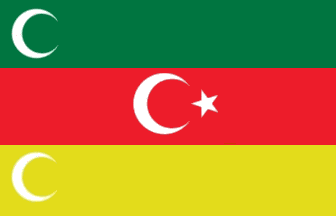
Later a new pan-Turkish organization of migrants to Turkey was created, named
Umid (Hope), and perhaps their flag is
three horizontal stripes green, red, yellow with two white half moons toward the
hoist in the green and yellow bars and in the red bar a white half moon and
star. Christian Kretowicz send me this flag but its attribution is uncertain.
Meskhetians Turks use also in the XXI century an orange flag (orange seems
to be a pan-Turkish color) with a black disc in the center and in that a white
star of 32 points; within the star is a black bicefalic eagle. This flag seems
to be the first one used by DUNYA AHISKA TURKELERI BIRLIGI but was later
discarded.
The Meskhetian flags are rarely used, I assume because,
following the Turkish system, the Ahiska /Meskhetian organizations now use the
white flag with the logo, as their members are strongly influenced by Turkey and
a national flag like the one with the green vertical stripe lost its place in
favour of civil organization flags.
Jaume Ollé, 26, 27 August 2026